


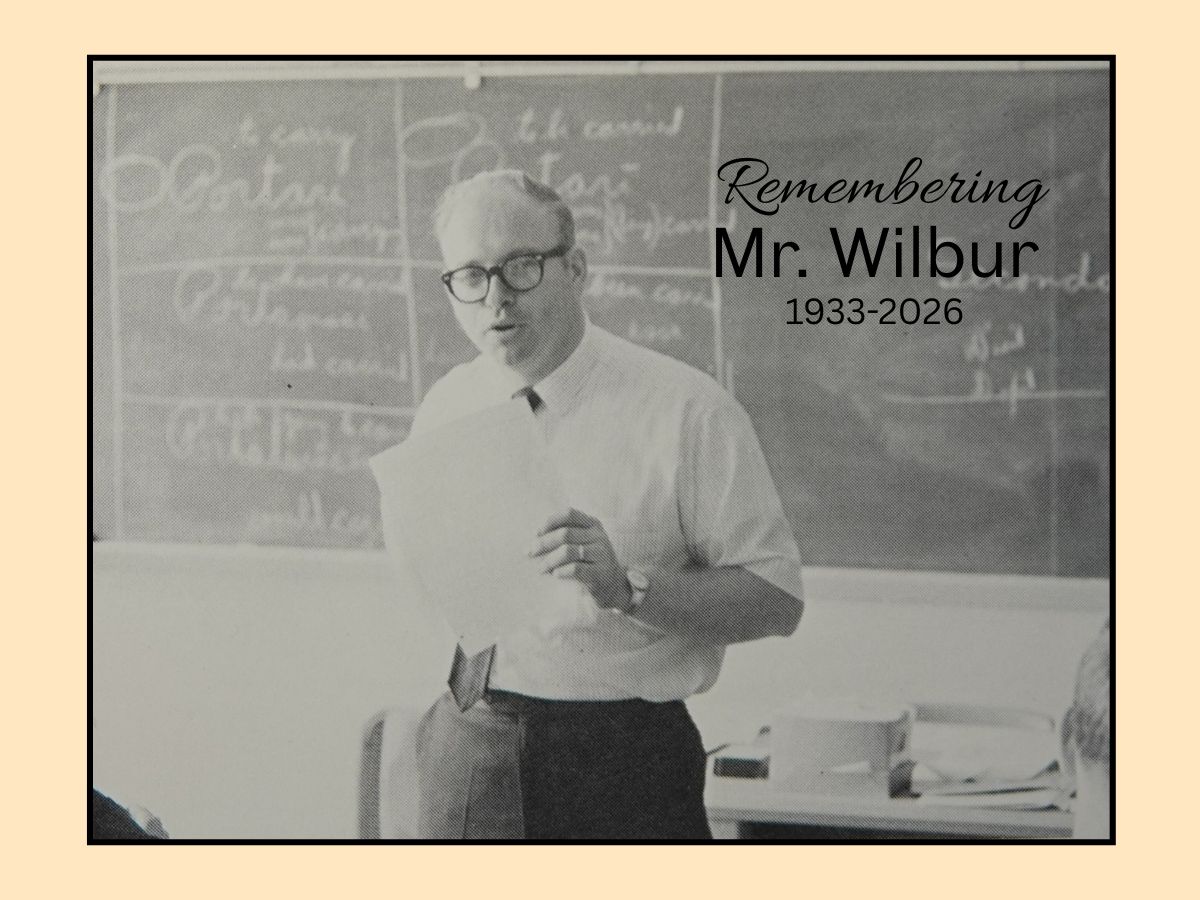
George E. Wilbur, 92, of Mapleton, PA, died on Monday, January 5, 2026, at Penn Highlands Hospital in Huntingdon.
Wilbur served the Tyrone Area School District for 33 years as a middle and high school teacher, retiring in 1996. Wilbur taught English, World Cultures, and Latin, but he was best known as Tyrone’s Latin teacher.
Many former students and colleagues shared warm stories about Wilbur, an intelligent and caring person with a gentle nature and a genuine love of teaching.
“Mr. Wilbur was a quiet, wise man who was humbly full of knowledge about so many things, had high expectations, and had a way of making everyone feel important. Mr. Wilbur had a profound impact on many staff and students,” said Leslie Estep, a former student, colleague, and the current Tyrone Superintendent of Schools.
Mr. Wilbur was beyond gifted at working with young people and was the kind of teacher who never failed to see the potential in his students and never passed up an opportunity to teach a life lesson.
“My favorite memory of Mr. Wilbur…was also one of my worst experiences at TAHS,” said Matt Swayne, a 1984 graduate, recalling the day he was caught using a cheat sheet in Mr. Wilbur’s class.
“He asked me to sit down, then made the class do a reading lesson on the honesty and integrity of man. He never yelled. Never embarrassed me. But that reading lesson was worse than any form of corporal punishment I can imagine. Trust me, that lesson stuck.”
Swayne said Wilbur’s influence went beyond Latin drills and classroom routines.
“What I do know is that although Mr. Wilbur is gone, those lessons remain: the knowledge he gave us, the hunger to learn, and the desire to live with honesty and integrity, even when we fall short,” he said.
Wilbur’s commitment to his students was clear. Despite a fairly long commute, he was often the first person in the building and the last to leave.
“Many days, Mr. Wilbur could be seen in his classroom long past the end of the school day, preparing his classroom to welcome his beloved students for another day of learning,” said Colleen (Stem) Biem, Tyrone Area High School Class of 1993.
He was also extremely organized. In the days before photocopiers and computers, Wilbur had decades of meticulously hand-printed projector transparencies of every page of every lesson at the ready.
“On the first day of class, he’d give everyone their own notebook. Part of our daily tasks was to transcribe his transparencies to our notebooks. We were graded on this notebook. He knew his material so well that he could usually just flip through your notebook and he’d know exactly how much work you’d done,” former student and TAHS class of 1999 grad Jonnie Gummo said.
Long before differentiation became a buzzword in education, Wilbur would teach several levels of Latin in the same classroom, and somehow kept track of all his students’ progress.
Christel Barr Grazier, a 1975 TAHS graduate, remembered Wilbur’s warmth.
“Every day he greeted students with a heartfelt and genuine smile and commitment to touch us with his knowledge,” she said. “He always was patient, passionate, and enthusiastic about reaching his students.”
Former students also remembered Wilbur’s respect for others that set the tone for his classroom.
“They say people don’t remember you for what you did, but how you made them feel,” former student Erin L. Adams said.
“He always treated us and spoke to us like we were adults and never talked down to us, being young kids,” said Curtis Brodzina, a 1999 graduate. “We didn’t know why at the time, but we respected that, and nobody ever gave Mr. Wilbur any trouble.”
Wilbur’s classroom was a place where history and a long-dead language came to life.
Mark Molnar, a 1993 graduate, said Wilbur’s passion for his subject set him apart from other teachers.
“George Wilbur was a teacher like no other,” Molnar said. “His passion for the ancient world was obvious from minute one. He shared it with his students without reservation.”
Molnar said Wilbur’s lessons ranged from the birth of civilization and democracy to mythology and chariot races, and that his curiosity was contagious.
“When you were in his class, you had no choice but to feel the same way,” Molnar said.
Wilbur’s message, Molnar said, was that students should not just absorb and recite information, but surpass their teachers.
“He would teach [us that] Socrates was the first great teacher. His student Plato surpassed him. Plato’s student Aristotle surpassed him. He told us we needed to surpass him,” Molnar said.
Scores of students at Tyrone learned Latin under Wilbur, not because they had a deep interest in the long-dead language, but because they were inspired by the man who taught it.
“I always wanted to take a Mr. Wilbur class,” Molner said. “Five years of Latin, yikes! But in his room, it never felt like work.”
Many former students remembered his unique grading system.
“When the end-of-period grading time came around, he’d have each student write him a letter stating what grade we felt we deserved, and why,” Gummo said. “He’d write back, disclose the grade he had recorded for us, and why. If we disagreed, he was open to negotiation.”
Gummo and many of his former students also remembered Wilbur’s personal grading scale that pushed students to do better.
“In Mr Wilbur’s class, you could receive an assignment grade as high as an A+++, or as low as an F- – -,” Gummo said.
Tyrone alum Amber Patton-Quartz echoed the “A+++” detail as something that she still smiles about, remembering Wilbur as the kind of educator who “wanted nothing more than his students to do well.”
Retired TAHS ag teacher Bill Harshman, a colleague of Wilbur for 17 years, spoke very highly of both his teaching skills and his character.
“Mr. Wilbur was a professional of the nth degree,” Harshman said. “He was interested in our vocational students just as keenly as his Latin students. A true gentleman who also was a most devoted husband.”
Current TAHS Social Studies teacher Suzy Burket, who also worked with Wilbur for many years, got to know him beyond the classroom. She described Wilbur as “a very intelligent, very sweet man,” who loved sporty cars, driving a black Saab for many years, gardening, and working on his property. But most of all, she said, “he loved his wife and children and spoke about them often.”
Burket recalled a specific moment that captured Wilbur’s kind nature: one day, a seventh grader wandered toward the back of his desk. Wilbur extended his arms to block off the area, but the student interpreted the gesture as an invitation for a hug and wrapped his arms around him.
Wilbur’s response was immediate and human. “What else could I do at that point? I gave the little guy a hug,” Wilbur said.
Decades later, many former students describe Wilbur as the best teacher they ever had.
“There cannot be a greater example of what a teacher should be,” said Class of 1993 grad Laura Newlin. “I am so grateful for the legacy he left through his students in his time as a teacher in Tyrone. He will not be forgotten.”
And for those who want to sum Wilbur up in a line he would have appreciated, former student and colleague Steve Everhart offered a fitting tribute, in Latin, of course:
“I don’t know what George Wilber has chosen for an epitaph, but here’s a suggestion he would appreciate: ‘Non eodem modo nunc creantur’…‘They don’t make them like that anymore.’”
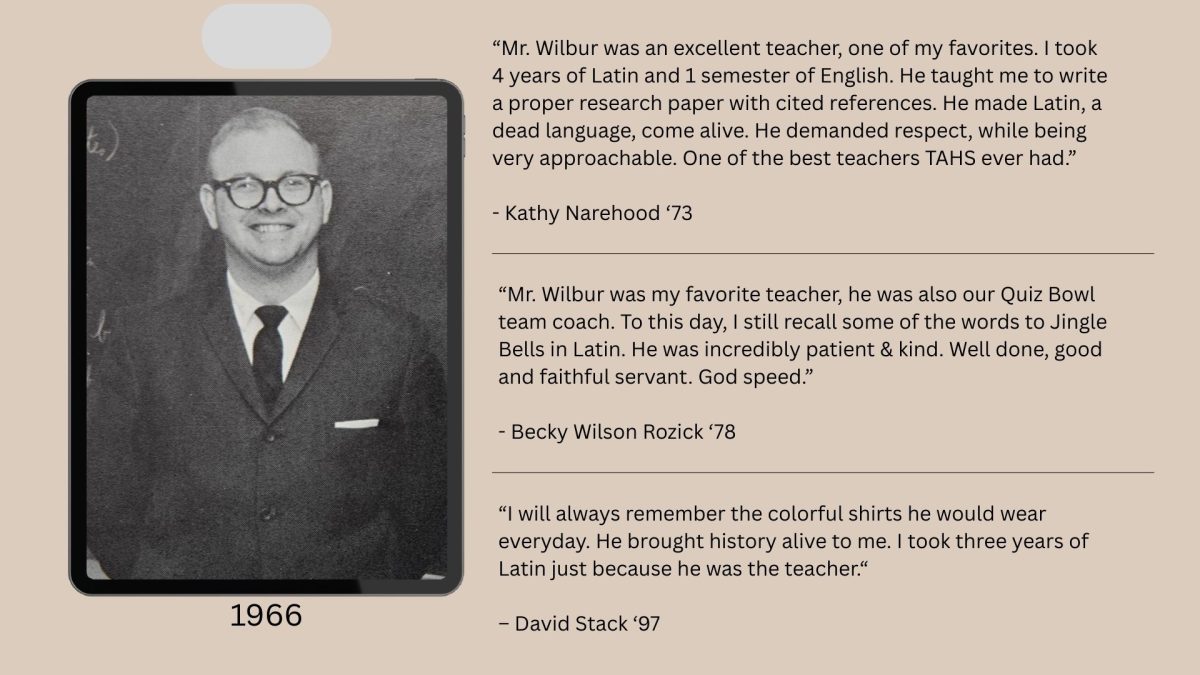
To read all the remembrances shared with the Eagle Eye, click the slideshow below:


George Wilbur • Jan 19, 2026 at 6:27 pm
This was a wonderful tribute to my father. Thank you all. I especially enjoyed seeing the dew-drop shirt. George G. Wilbur, son.
Fred Kaspick • Jan 18, 2026 at 12:35 pm
Yep, these remembrances echo my experience and recollections of Mr. Wilbur. One I didn’t see was his love of music and the organ he had in his home at least when he lived up the street from the Citizens Firehall. It was the 1st one I had ever seen that one could play into headphones thereby not disturbing others such as the two boys I recall him bringing to class one day and yes, I too now have one I can do the same with. Several good teachers from my time at TAHS but I also judge him my favorite. Class of ‘69